Showing posts with label video games. Show all posts

22 April 2014

Review: Ogre Battle: The March of the Black Queen

Hola, amigos. I know it's been a long time since I rapped at ya, but I've had quite a busy year. I got married. My wife and I went to Italy. We moved into a townhouse. A bunch of my friends got married and/or had kids. I'm still working nights and weekends. And to top it all off, my wife and I are expecting a beautiful baby girl in a month. Needless to say this has cut down on my gaming and blogging. But right now I feel like it's time for a little nostalgia.

About a year and a half ago, I asked my wife (then-fiancée) for a PS Vita as my big Christmas gift. We had a lot of travel planned for 2013, and I wanted to play Final Fantasy Tactics: The War of the Lions and possibly see what the Dissidia nonsense was all about. Then, about two weeks before our wedding, I discovered a title I recognized from my past on PSN -- Tactics Ogre: Let Us Cling Together. Many moons ago, I really enjoyed Ogre Battle: The March of the Black Queen on Super Nintendo. Unfortunately I never actually found a copy to buy, which is a bummer because they now go for over $100 (way more if it includes original packaging) due to a limited number of copies released in the United States. So I just rented it from Blockbuster about a dozen times instead. And later in my gaming career, of course I fell in love with Final Fantasy Tactics. Therefore I figured Tactics Ogre would be the perfect combination of those two games. I bought the PlayStation version, and after playing through most of the game I came away feeling very meh about the whole experience, mostly because of the way classes worked and the 100-floor "optional" dungeon (nothing is optional in RPGs). But my attitude changed this past year after finding a Let's Play thread about the new-ish PSP port on Something Awful forums. Square Enix brought back the original production team to clean up some of the shoddy mechanics and add content for the new release, and after toying around with it more than I'd care to admit (especially on our honeymoon, there are long train rides in Europe, don't judge me) the game reignited my interest in the entire Ogre Battle series. Flash forward to a few months ago, when the ease of NHL 14 and my reluctance to join my friends on Final Fantasy XIV led me to fire up the ol' SNES emulator and play the original Ogre Battle once more.

A revolution in under a year? I guess it helps to have dragons and magic.
More after the jump...

17 July 2013

Civilization V: Gods & Kings - Rome

In a previous post, I commented that I got bored with Civilization V rather quickly. I found the replay value to be lacking because it seemed like there just wasn't enough to do. You build, you go to war, and most of the time you win. At the higher difficulty levels, there just weren't enough ways to get around the advantages the of the computer-controlled players. But with the Gods & Kings expansion, it added not only a new religion mechanic, but added more of everything to make gameplay more varied. In the past few months, I've been playing it a lot, and the "one more turn" addiction has taken hold of me once more. I want to experience as much of the game as possibly before buying the brand new expansion, Brave New World, which changes culture entirely and adds a new tourism mechanic.

With that in mind, I'm going to be recapping some recent games I've played. I hope you enjoy them, I know I did.


ROME - AUGUSTUS CAESAR

Unique Ability: The Glory of Rome (+25% Production towards any buildings that already exist in the Capital)

Unique Unit: Ballista (+1 Combat Strength and +2 Ranged Combat Strength over Catapult, which it replaces)
Unique Unit: Legion (ability to build roads and forts, +3 Combat Strength over Swordsman, which it replaces)

Map Size: Standard (8 civilizations, 16 city-states)
Map Type: Continents
Difficulty: King (5)
Pace: Standard

The Romans are pretty great for an "infinite city sprawl" (ICS) strategy since any building that exists in Rome is built much faster in every other city in your civilization. In other words, you can build tall and wide with Rome. The problem becomes managing your gold and happiness, as lacking in either will give the computer players a big advantage, especially on King difficulty. My strategy is to build tall at first, then go wide when I can afford happiness and science buildings. A domination victory is difficult because you need science to research new units, gold to keep them upgraded, and happiness to offset the penalty of conquering cities. If anyone can do it, it's Caesar. (Well, him and Napoleon, but I don't like the French.)

I didn't take screenshots during the actual game, but I will try to tell the story of my victory through the replay maps.

Turn 1: I found Rome, one turn later than everyone else founded their capital, in the northwestern part of the eastern continent. To my east the Netherlands are light orange and white, to the south the Incas are gold and green, and finally on the extreme other end of the continent the English are burgundy and white. The western continent has the Polynesians in orange and white, the Spanish in dark red and pink, the Egyptians in yellow and purple, and the Austrians in red and white. All of the black territories are city-states. This is a good starting location because I have a nice buffer between Rome and London. Queen Elizabeth I can be very aggressive with expansion and military strength, so I wouldn't want to go to war with her until adequately prepared.

Of course, I don't know any of this. All I know is that Rome got lucky by starting on a hill next to a river, with wine and marble nearby. Marble is especially nice since it provides the same happiness as other luxuries in addition to speeding up wonder construction.

More after the jump...

13 April 2013

Review: Final Fantasy XII

After my review of Final Fantasy XIII-2, I theorized that it wouldn't be long before we saw another direct sequel. Turns out I was right. But since that experience left me battered and bruised emotionally, I decided rather than wait for the (hopefully) final installment of the saga of the Farron sisters, I would go through older Final Fantasy titles in order to remind myself of why I enjoy them so much in the first place. My recent reviews of The Legend of Zelda franchise have moved forward down the official Zelda timeline. In the Final Fantasy series, however, the settings are completely separate worlds with no chronological order, giving me no clear direction with which to work. But I figured it would just be easiest to go in reverse order of the release of the major installments. Plus, if I went down that road, the next game up contained that one superboss I could never get to... Therefore, I hooked up my old PlayStation 2 slimline and returned to the world of Ivalice and Final Fantasy XII.

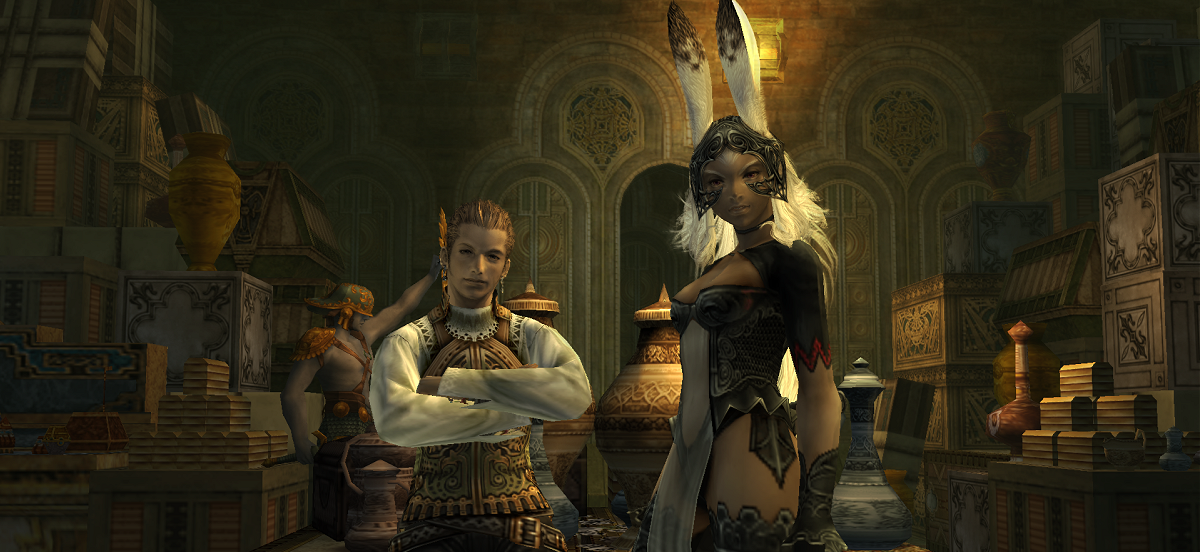
Oh, yeah! It's my old friends, Swashbuckler and Bunnytits!
In the six years and change since I bought XII on the day it was released (I even shelled out the extra dough for the Collector's Edition!) I had yet to visit the final dungeon. It seems strange that I never finished a game that I enjoyed playing, even if it wasn't my favorite title in the series. It's just that the dungeon right before the end is about one hundred floors, and the game's real challenges stem from defeating optional bosses and acquiring rare items which have nothing to do with the main storyline. Speaking of, this is also the point in the story when things start to go a little batshit insane, although I do have to give the developers credit for not tacking on some needless trip to outer space (spoiler alert!) or something equally stupid. But in the interest of completion, I finally beat the last boss, watched the end credits, and now I can safely say that I wish I had never gone back to this game.

I should have left you under the TV stand, covered in dust. :-(
More after the jump...

08 November 2012

Review: The Legend of Zelda: The Minish Cap

After finishing Final Fantasy XIII-2, I didn't play any new video games for a while. First of all, my spirit was crushed by the weight of Square Enix's complete and utter failure. Also, the weather was finally nice enough to actually go out-of-doors with regularity. I did pick up Civilization V, which I enjoyed quite a bit but found the replay value surprisingly lacking. I even went back to an old stalwart, Heroes of Might and Magic III, which I'm happy to report I still play every so often. But eventually I decided on continuing down the Zelda timeline and playing through my first handheld game in years, The Legend of Zelda: The Minish Cap. It only took me a couple of weeks to explore everything, even with working full-time and five fantasy football drafts to plan for, but no one expects massive amounts of content from an eight-year-old handheld game. What I did expect was vintage Zelda gameplay in bite-size form, and in that, The Minish Cap delivers with aplomb.

Consistently crisp and refreshing, the Zelda franchise satisfies. No, it's not a beer or a candy bar.
I loved the look and feel of The Minish Cap almost immediately. It reeks of an updated Link's Awakening (which I played and replayed religiously as a kid) and the plot continues the threads from Skyward Sword. This was my first experience with game developer Flagship, a subsidiary of Capcom who also worked on Four Swords and the two Oracle games. Their expertise in handheld gaming is evident, as the nuts and bolts of The Minish Cap all feel right. The scale and graphics are wonderful, the controls feel natural, and the dungeons and tasks are short enough that the player won't run out of battery life just before a boss fight. Keeping things short and sweet on a handheld platform is essential, and director Hidemaro Fujibayashi and his team accomplish that goal extremely well.

As mentioned above, The Minish Cap begins with a nod to the world of Skyward Sword. The introduction tells of darkness descending on the land of Hyrule long ago, when a race of very small creatures called the Picori came from the skies (possibly alluding to Skyloft) to bestow a sword and a golden light on a young hero. The hero banished the darkness, locking the evil beings in a bound chest, and the Picori Blade was enshrined by the people of Hyrule. Every year since, they remember the gifts of the Picori in an annual festival. Seems like a standard backstory, but there are two things I appreciate. First, it hints at an untold story of a former Link, one whose adventures would take place between Skyward Sword and The Minish Cap. As the Zelda franchise has grown and changed over the years, Nintendo has done a nice job of tying together themes and stories, and I wouldn't be surprised to see a future Zelda title cover the Picori's initial trip to Hyrule and the hero they encountered. Second, it tells the story of a legendary sword other than the Master Sword, which as we eventually learn in other games, is tucked away in the Sealed Grounds. Instead, the Picori Blade is Link's weapon of choice, and The Minish Cap details how it eventually becomes the Four Sword. It's a fun little story, perfect for both the setting and the handheld console.

I always love way-epic stained glass windows.
More after the jump...

15 May 2012

Review: Final Fantasy XIII-2

If you read my review of Final Fantasy XIII, then you know that I had a lot of things to nitpick in that game, especially in terms of good supporting characters and the ability to explore the world at large. So I was encouraged to learn that Square Enix developed and completed Final Fantasy XIII-2 less than two years after the original, with the previous game's shortcomings still fresh in their minds, and also with input from fans across the globe. I admit that it is quite dangerous to let the die-hard Final Fantasy geeks control any actual game content, for fear of skimpy outfits, Sephiroth-esque villains, and general Japanophilia. But I was willing to accept this risk if it meant fixing the glaring flaws of a game and a setting in which I saw so much potential.

Square Enix... fans... you have all let me down.

zomg bigger swordz!!!!11 lol
XIII-2 gets some things right. First and foremost, it keeps largely intact the excellent battle system used in XIII. There are minor tweaks to how the player can control the battle, some good (changing the leader) and some decidedly bad (fewer actions available to playable characters) but it all amounts to a lot of fun. The addition of the Paradigm Pack system, which allows for the player to capture monsters and use them in battle, is excellent. Developing and customizing each monster you catch can be unique and great to experiment with, if you don't mind a bit of farming (and let's be honest -- anyone playing a Final Fantasy game doesn't). And while I have never played any of the Pokemon games (I KNOW RIGHT) I have been assured that it is different enough from that system to pass the originality sniff test, while still keeping some of the series' best monsters.


Familiarity is a good thing.

More after the jump...

27 February 2012

Review: The Legend of Zelda: Skyward Sword

Two things initially got me very excited for the release of The Legend of Zelda: Skyward Sword. First, it was released only for the Wii and required a Wii MotionPlus controller, which meant maximum flailing about the living room on my part. Second, I read that in the official timeline released by Nintendo (it's about time, no pun intended) Skyward Sword is the first, and will represent the origin story for all other Zelda titles to date. To me that meant the story was likely way epic, and given the series' history of mixing a great story with lighthearted fun, I was extremely optimistic. Besides, it's hard to screw up a Zelda game. They stick to a formula that works, and they do their best to nail it.

Tell me you're not just a little bit cised right now.
Being one of the bigger nerds of all time, I asked my fiancée to get me Skyward Sword for Christmas. I figured it was a good gift idea, being that I would buy it anyway, and I was struggling for anything else I needed at the time. It was the perfect plan, but for the fact that we had Christmas with her extended family and I had to explain to them why I asked for a video game. I should have just said, "I'm a man-child," gotten in my car and driven home, never to return. Sometime shortly after New Year's (after I finished up Final Fantasy XIII) I dove right in to Skyward Sword.

More after the jump...

01 February 2012

Review: Final Fantasy XIII

In anticipation of Final Fantasy XIII-2's U.S. release at the end of January, I just finished replaying Final Fantasy XIII. First, I wanted to get the Treasure Hunter and Ultimate Hero trophies (because online achievements matter!).

Proof.
But I also wanted to re-familiarize myself with both the story and the battle system. After doing so, it seemed like the perfect time to offer up a review. Actually, not the perfect time, considering it was first released over two years ago, but I digress.

The first time I played through the game, I remember not really liking the story in general. Right off the bat, Square Enix and XIII director Motomu Toriyama break the "Robert Jordan Rule," which is of course if you make up more than three words at the beginning of a story, you're going to lose a lot of people, and the story had better be pretty damn good. The first few cutscenes were throwing fal'Cie, l'Cie, and Cie'th around quite a bit, and frankly becoming a l'Cie doesn't sound so bad. Not to nitpick, but the most crucial part of any game's story is communicating where you are, what you're doing, and why you're doing it. And given the gameplay restrictions inherent in the early chapters, going to the well of "saving the world," and rescuing some girl the audience knows nothing about from becoming encased in carbonite crystal isn't exactly a great or original motivation. As the story progresses, and our protagonists are off to stop the evil gods and/or organizations, there is still an uncertainty about why, or how the group will accomplish their halfhearted goals. During the mid stages of the game, most of the main characters grow and become more dynamic, but some of them continue to play one note throughout, and the supporting characters offer little distraction. By the time we definitely know what were doing (only because we're told so in James Bond, villain-reveals-all-and-splits fashion) and we're ready to do it, there are only two chapters left and it's basically LIGHTNING AND FANG SMASH to the last boss.

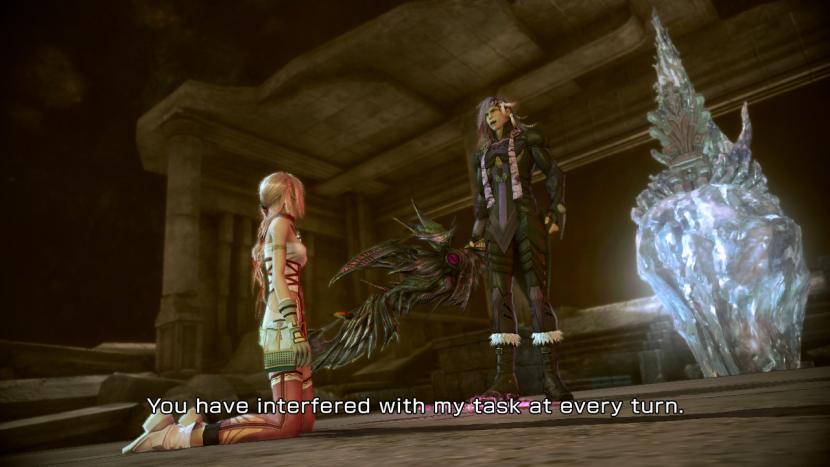
"This is only the first time we've met. I'll tell you my exact plan next time."
More after the jump...